


TL;DR: Fifty aikido practitioners shared their injury stories - the consistent lesson is practitioners learn the hard way that safety comes first, revealing teaching gaps that made injuries inevitable.
My shoulder hurt for a full year after a botched throw. The dull, constant ache became a relentless reminder every time I took ukemi, and when my doctor ordered a break, I refused. The injury became my forced teacher.
Unable to muscle through techniques, I had to internally re-map my movement. I became intensely mindful, feeling my way through throws and pins to find subtle, pain-free shifts in weight and angle.
This necessity led to a fascinating discovery: multiple internal pathways exist for the same external technique. Pain helped me overcome blockages, revealing movement options I hadn’t known existed and achieving a more subtle practice.
Later, my knee went – meniscus damage from shikko. Another season of pain, surgery, and forced re-mapping only deepened that original lesson.
I wondered if others experienced this, so I asked the Aikido community on Reddit what their injuries had taught them.
What the community learned
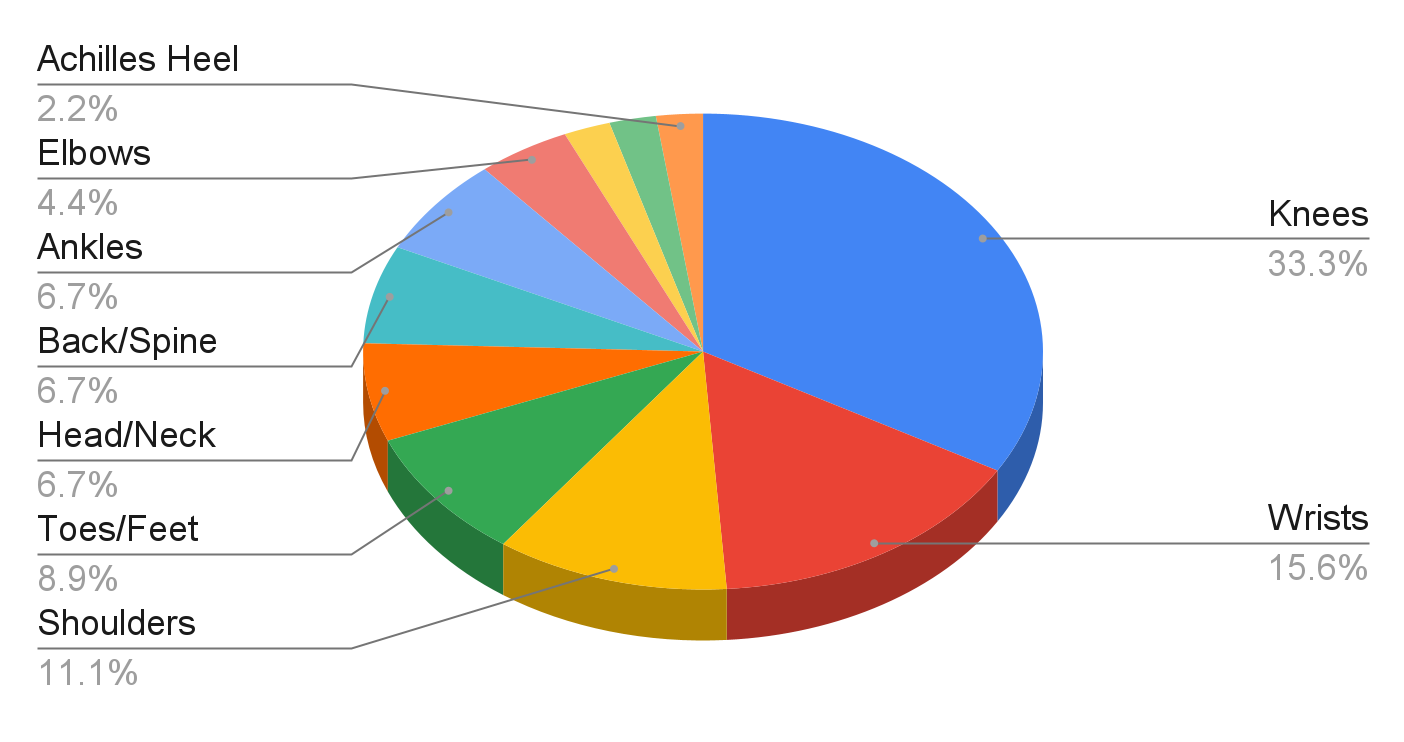
After reading through more than 50 personal accounts, a clear sequence of injury and suffering emerged, crossing all styles and levels. The journey from beginner to advanced practitioner is marked by three primary battle scars: shoulders, wrists, and knees.
The beginner’s tax: Shoulders
Shoulders are often the first casualty—the beginner’s tax. Too stiff, too slow, resisting a fall – the shoulder absorbs the shock of unlearned ukemi. Many reported that they only finally learned to relax after the pain forced them to.
The mid-level threat: Wrists
As proficiency increases, the danger shifts to the joints most exposed during controls. Wrists come next, mostly from misaligned locks and partners who don’t control their finishes. Sankyo, nikyo, and shihonage appear in too many stories. A brief surge of tension or pride is enough to cause an injury that requires months of recovery
The advanced practitioner’s fate: Knees
Knees ultimately suffer most. The culprits are familiar, insidious, and cumulative: tenkan done with planted feet, zagi that grinds the joints, and bad long-term ukemi. Smooth, modern mats make sliding easy – and long-term damage invisible. The reality is summed up in this dark joke from the community: “I don’t think there’s a 7th dan who hasn’t had knee surgery”.
Collateral Damage and Ego
Beyond the primary three, practitioners endure toes, backs, and ankles – collateral damage from bad falls or crowded mats. One person summed up the sheer variety: “sprained hip, torn labrum, and ‘sprained ass muscles,’ ending with, “The list is endless.”
But the worst, most universal injury is not physical. It is what compels us to ignore the warnings and keep training: “Ego and feelings. OOOOOHHHHH!” – a comment earning a knowing laugh from everyone who has ever pushed too hard.
The hard-earned wisdom
The most repeated insight is simple: safety before ego. Practitioners wished they had slowed down, prioritizing smooth and aware over fast and strong. This philosophy is best summarized: “The first goal in Aikido should be safety – ours and our partner’s. Everything else follows.”
Training Partners
Injuries forced practitioners to choose partners carefully. The consensus is that beginners are inherently dangerous, especially when you are tired. The hard lesson: “Go join the blackbelts/advanced students, they will take care of you. A beginner might let you injure yourself.”
The caution extends to all ranks: Be “ultra cautious when training with people I don’t know,” because even a Dan grade doesn’t guarantee a perfect or safe technique.
Technical corrections
Pain forced specific, fundamental corrections that many only fully understood after an injury:
Footwork: Pick up your feet during tenkan to stop twisting on planted joints.
Seated Movement: Keep your feet underneath you and avoid leaving a foot behind during shikko (knee-walking).
Ukemi: Never fall directly onto your knee during ushiro ukemi (backward fall).
As one person reflected, “I learned more about reconstructive training in recovery than in years of regular practice,” concluding that the injury ultimately taught them “how to not hurt myself.”
The cracks in teaching
Beyond personal lessons, some practitioners saw deeper issues. They noticed that many injuries start with how aikido is taught. “The vast majority of coaches just parrot what they were taught,” one commenter said. “They don’t really understand taisabaki — body movement — from a skeletal or kinetic standpoint.”
Others blamed dojo culture: pressure to go fast, to look good, to match a teacher’s rhythm instead of one’s own. “I realized joy in aikido isn’t always shared,” one person wrote. “For many, the end goal is power until they reach some kind of spiritual awakening. Injury might just be inevitable on that path.”
Another practitioner described leaving his dojo after a dislocated shoulder: “I should have trusted my gut. My partner was resentful of the instructor, and I was in the wrong place at the wrong time. If I could go back, I’d have left early.”
The quiet wisdom of pain
Over and over, the same theme appeared: pain forced reflection. It slowed people down enough to see what was really happening in their bodies and dojos. A few found that it even improved their aikido. “Since those days,” one wrote, “I understand a little about aiki and subtle kuzushi. I no longer muscle techniques, and I can look after my uke better.”
Some saw humor in hindsight. “Growing old ain’t for sissies,” one veteran wrote after listing decades of joint injuries. Another said his only regret was that it took pain to make him train smarter: “Maybe I just mellowed with age — or maybe I finally wised up.”
What all this means
If there’s one rule hidden in hundreds of bruises and surgeries, it’s this: the body remembers what the ego forgets. Pain is information. It teaches alignment, humility, and presence better than words ever could. Every practitioner eventually learns it – some gently, others violently.
Aikido’s principles are supposed to protect, not punish. But the way we train often blurs that line. We speak of harmony, yet push through resistance. We say relax, yet chase rank and speed. The result isn’t just physical strain — it’s a cultural blind spot where injury becomes normal instead of instructive.
Pain can be a teacher, but it shouldn’t be the curriculum.
The first law of the dojo
The mat is not a battlefield. It’s a laboratory. Each fall is feedback, each ache a quiet reminder: awareness matters more than ambition. As one practitioner wrote, “Going slowly and smoothly is always better than trying to be fast.”
Maybe that’s the truest aiki lesson of all – not avoiding conflict, but moving through it with attention.
That’s what Part 2 explores – why aikido keeps producing the same injuries despite decades of experience, and what needs to change in how we teach and train.
If you’ve been injured in aikido, what did it force you to learn? Share your experience in the comments, especially if you discovered something unexpected about how you move or train.
Your phrase, 'The mat is not a battlefield. It’s a laboratory' is perfect. I hope you don't mind me quoting you?
You asked about other people's experiences, I will share this link with you (although the events were quite a while back, although it's quite personal, including x-ray). https://budojourneyman.substack.com/p/adventures-in-aikido?utm_source=publication-search