


TL;DR: Aikido injuries reveal a systemic teaching gap – knowledge exists but doesn’t transfer, instructors repeat what they learned without understanding why, and the community has no mechanism to identify or promote better teaching.
In the first part, we saw how pain forces practitioners to re-map movement and discover lessons their teachers never explained. But the question remains – why do these same injuries keep happening decade after decade? Why do so many aikidoka learn only after getting hurt?
Across dozens of testimonies, one uncomfortable truth emerges: aikido’s injury patterns are systemic, not accidental.
The culture of self-blame
Most practitioners blamed themselves. They said they were careless, too stiff, too tired, or pushed too hard. Few mentioned their teachers or dojo culture. That silence says a lot.
“I should have listened to my body,” one wrote. “I was trying to look good for a grading.” Another said, “I knew I shouldn’t train with beginners when I was exhausted. My fault.”
Self-responsibility is valuable, but the pattern reveals something deeper: aikido’s teaching culture conditions students to internalize all fault. Pain becomes a private failure, not a collective warning. The dojo absorbs no responsibility, and so the system never learns.
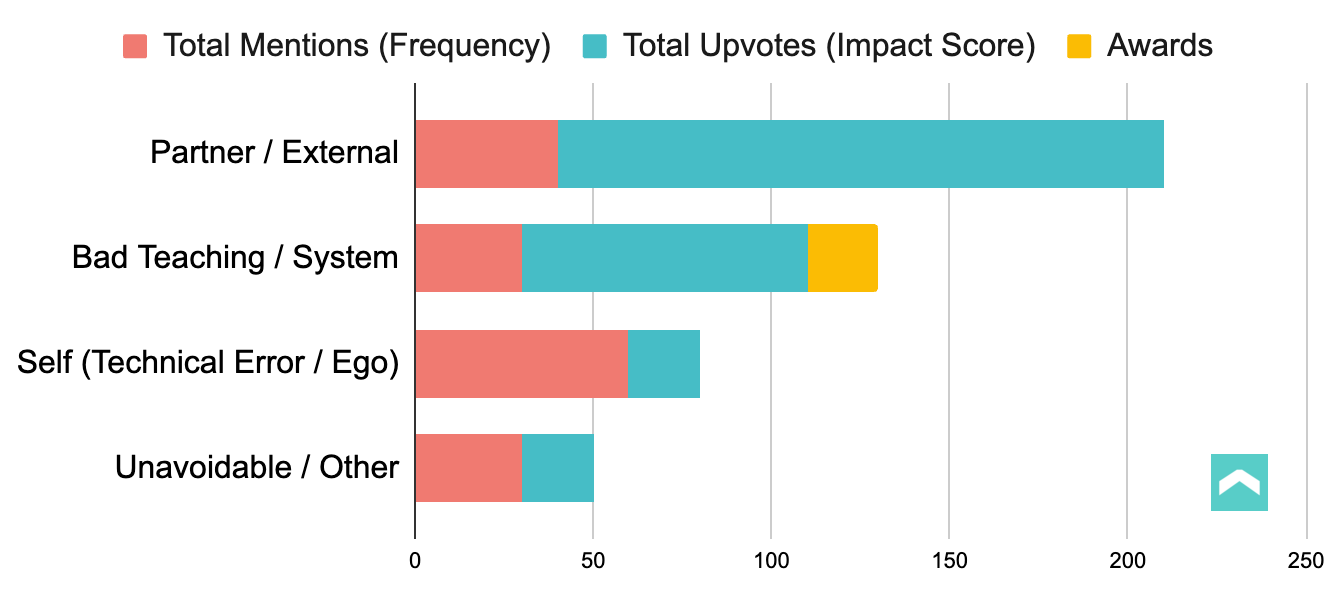
The analysis of injury blame shows a complex pattern. While self-inflicted error is the most frequently mentioned cause of injury, community consensus (measured by upvotes and awards) assigns the highest impact to external factors. Practitioners tend to blame themselves, yet the broader discussion points to poor partners as the source of the worst injuries – and to the instructional system as ultimately responsible for not preparing them for either scenario.
When tradition becomes repetition
A recurring theme was parrot teaching – instructors repeating forms without fully understanding the principles behind them. One practitioner who went on to study the topic deeply at university after an injury wrote:
“The vast majority of coaches are just parroting what they were taught, often worse than they received. They don’t really understand taisabaki – body movement – from a skeletal or kinetic standpoint. The knowledge was there once, but it’s been lost.”
This loss of depth creates two outcomes: poor movement models and unsafe dojos. Without a clear understanding of biomechanics, even sincere instructors can unknowingly pass down habits that damage joints over years.
Another comment pointed out a generational gap:
“Most clubs are run by older instructors without planned successors. It’s not a fluke. We’ve lost five generations of coaches.”
The invisible pressure to conform
Aikido is supposed to be non-competitive, yet the social dynamics inside dojos often breed quiet competition. Practitioners push to impress instructors or prove toughness. “We say it’s about harmony,” one person wrote, “but there’s a hidden hierarchy of endurance. Whoever can take more pain earns more respect.”
Instructors rarely encourage this openly – but they also rarely stop it. The result is a dojo culture where restraint looks like weakness and injury becomes a badge of commitment. One commenter recalled being injured by a higher-ranked partner testing pins without consent: “I dislocated my shoulder. He dropped my hand, turned, and walked away.”
Missing pedagogy
Many stories pointed to a simple lack of teaching skills. A black belt might have decades of technique, but that doesn’t mean they know how to teach it safely. Several practitioners noted that aikido has almost no formal instructor training compared to other sports.
“If coaches were trained in anatomy or sports science, half these injuries wouldn’t happen,” one wrote. “We teach complex joint locks to beginners with no foundation in safe movement.”
Another practitioner described the shock of realizing how many things were taught without explanation: “For years, I practiced tenkan with my weight on the back foot. Nobody corrected me. Then my knees gave out.”
In other martial arts, biomechanics and conditioning are core parts of instruction. In aikido, they’re often treated as optional – something you’re expected to figure out by feel or faith.
This extends the conversation from this post:

The myth of harmlessness
Aikido is often marketed as a gentle art. That illusion makes injuries harder to discuss. “We’re told it’s safe for all ages,” wrote one veteran, “but the rate of knee surgeries among senior teachers says otherwise.”
Several practitioners noted that smooth mats and soft landings hide the real stress on joints. “You don’t feel it until years later,” one said. “Modern surfaces let you slide and torque without noticing.” The result: chronic injuries mistaken for aging.
Even small things like seminar overcrowding become accepted risks. One participant recounted, “I’ve seen multiple concussions from people colliding during ukemi at big events. When I said we should limit numbers, I got the kind of look you get when you question religion.”
Ego, speed, and the illusion of progress
Pain often begins with impatience – wanting to be fast, to master forms, to prove something. “Going smoothly and slowly is always better than trying to be fast,” one practitioner wrote. Yet most dojos reward speed and precision over awareness and control.
That same reward structure shapes how instructors evaluate progress. Students who move quickly look confident. Those who slow down to feel alignment seem hesitant. Over time, this creates a culture that praises external form over internal understanding.
The irony is that aikido’s very name – the way of harmony — points toward cooperation, not competition. But harmony can’t exist without safety. When ego enters, the body becomes collateral damage.
The emotional residue of injury
Beyond physical pain, many described the emotional shock that follows. Some left aikido entirely, not out of bitterness but disillusionment. “I realized joy in aikido isn’t always shared,” one person wrote. “For some, it’s about control, not connection.”
Others turned their injuries into catalysts for change. One practitioner said, “I learned more from reconstructive training than from ten years of practice.” Another used recovery time to study aikido history and movement science: “Necessity became invention. I started asking better questions.”
These are rare stories – not because others lack insight, but because most leave quietly when the art hurts them more than it helps.
What needs to change
If aikido is to evolve, it must stop treating injuries as personal failures. They are feedback – signals about how we train, teach, and organize practice.
Some dojos have already begun adapting: emphasizing functional conditioning, teaching biomechanics, and creating open dialogue about safety. In those places, progress is slower but more sustainable. Practitioners age better, move better, and stay longer.
At Aikicraft, our mission is to help both teachers and practitioners become more aware of these issues and to offer practical solutions. The Teach Better section (aikicraft.org/s/method) exists precisely for this reason – to bridge insight and action, turning awareness into safer, smarter practice.
But the broader culture still resists change. “We’re stuck between tradition and denial,” one instructor admitted. “People think talking about safety undermines the spirit of budo. It doesn’t – it honors it.”
Wisdom that the system forgets
Pain teaches what lineage sometimes forgets: attention, humility, adaptability. If aikido wants to stay alive, it must learn from its own bruises.
The injuries we ignore become the lessons we’re forced to repeat.