


TL;DR: The four elements aren’t mystical forces. Used as a teaching map, they give practitioners and instructors a shared language for what’s missing and what’s overdone. Two dojo exercises included.
I started using the four elements with adult students recently, and I’m still in the excited phase of testing what they reveal. The framework isn’t new to me as an idea. What’s new is how directly it works as a teaching tool when the audience is grown adults who want to know why their technique feels off.
A short note on what this is and isn’t. I don’t pretend to understand the deep philosophical implications of the symbols and elements in Aikido cosmology. I haven’t spent years in Japan reading the original Shinto and Buddhist sources. What I have done is teach for over two decades, and from that experience I can say the four-element frame is one of the most practical short-form maps I’ve added to my toolkit recently.
It sits alongside other approaches I’ve been exploring on Aikicraft, like progressive challenge and peer coaching adapted from sport science. The element framework adds something different: less about how you structure a class, more about what you and your students learn to notice at any given moment.
This piece is about that practical layer. Not the metaphysics.
A note on the philosophy
Two source systems often get blended in Aikido conversations.
The first is Sankaku, Maru, Shikaku: triangle, circle, square. These three forms come from Shinto cosmology (Gogyo Gogen) and were used by O-Sensei to point at entering, blending, and stability. It’s a trinity, not a four-element system.
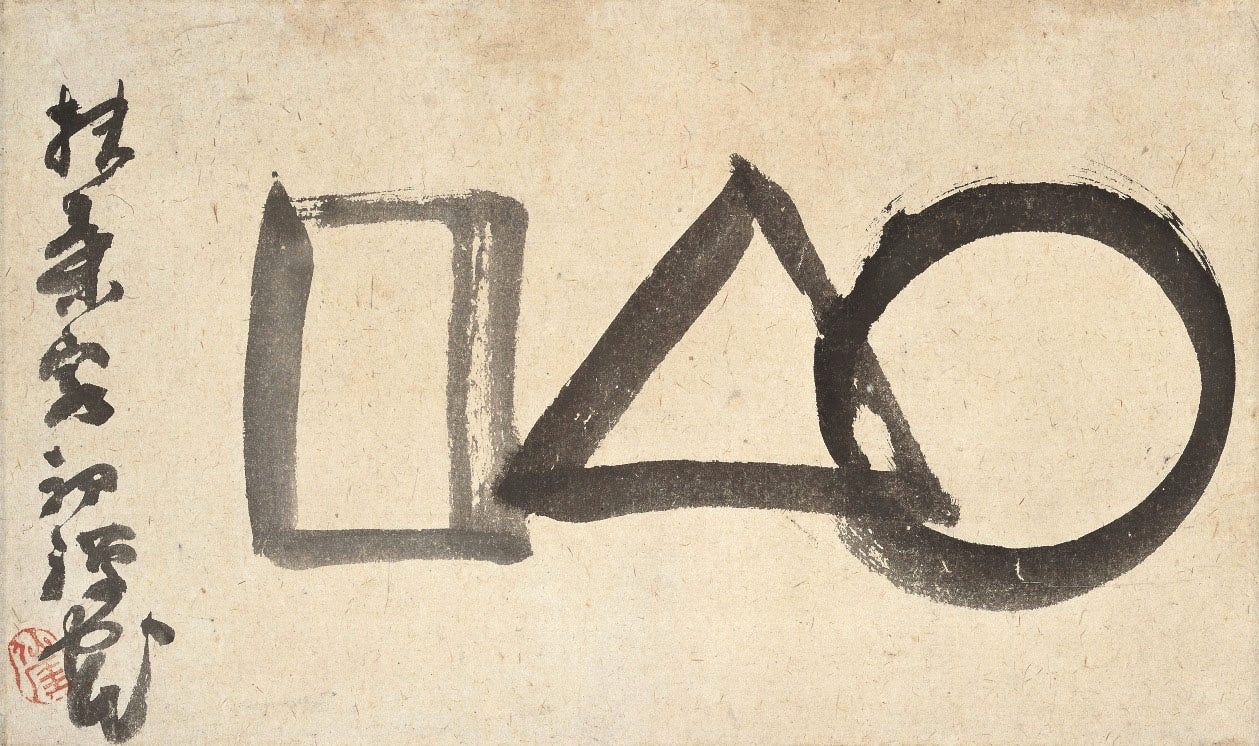
The second is Godai, the five-element Buddhist cosmology of earth, water, fire, wind, and void. Each has its own symbol. Wind has its own crescent shape. They aren’t the same system as the three forms.
Mixing them freely is common in Aikido writing. It also isn’t accurate. So I want to be clear about what I’m doing here. For teaching purposes I use a simplification: the three forms (square, circle, triangle) plus air, treated as four teaching qualities. Not a metaphysical claim. Not a claim of authentic transmission. A useful map, the way a good metaphor in any teaching context becomes a useful map.
The four-element teaching map
The qualities, mapped to recognizable Aikido phenomena.
Earth (square). Structure, posture, rooting, repetition. The four corners of stability. Earth shows up in hanmi, in solid kamae, in the patient repetition that makes a technique reliable. You feel its absence when a student’s stance keeps collapsing or their finish has no shape.
Water (circle). Flow, redirection, continuity, adaptability. Water lives in tenkan, in the way a circle becomes a sensation in the hips before it becomes a shape on the mat. You feel its absence when a movement stalls, breaks at the joints, or refuses to blend.
Fire (triangle). Entry, decision, intensity, commitment. The apex points at uke’s center before the foot moves. Fire is irimi. It’s the willingness to commit to the line. Without it, technique looks polite and goes nowhere.
Air. Breath, distance, awareness, the pause between movements. Air is ma-ai (”martial distance” or a dynamic balance point where you are safe from attack). It’s kokyu-ho. It’s the silence between the cue and the correction. Without air, the other three turn rigid (earth without breath), looped (circle without space), or sharp without purpose (triangle without timing).
The point isn’t to label movements. It’s to give yourself and your students a shared shorthand for what’s working and what isn’t.
There’s a parallel internal map I’ve worked with before on Aikicraft, looking at how relaxation, stability, and clarity develop as milestones in skill. The series From tension to flow. Part 1 covers that thread. The element framework here is diagnostic: what’s overused or missing right now. The tension-to-flow series is about how those internal qualities grow over years. They sit well together.
How we test it on the mat
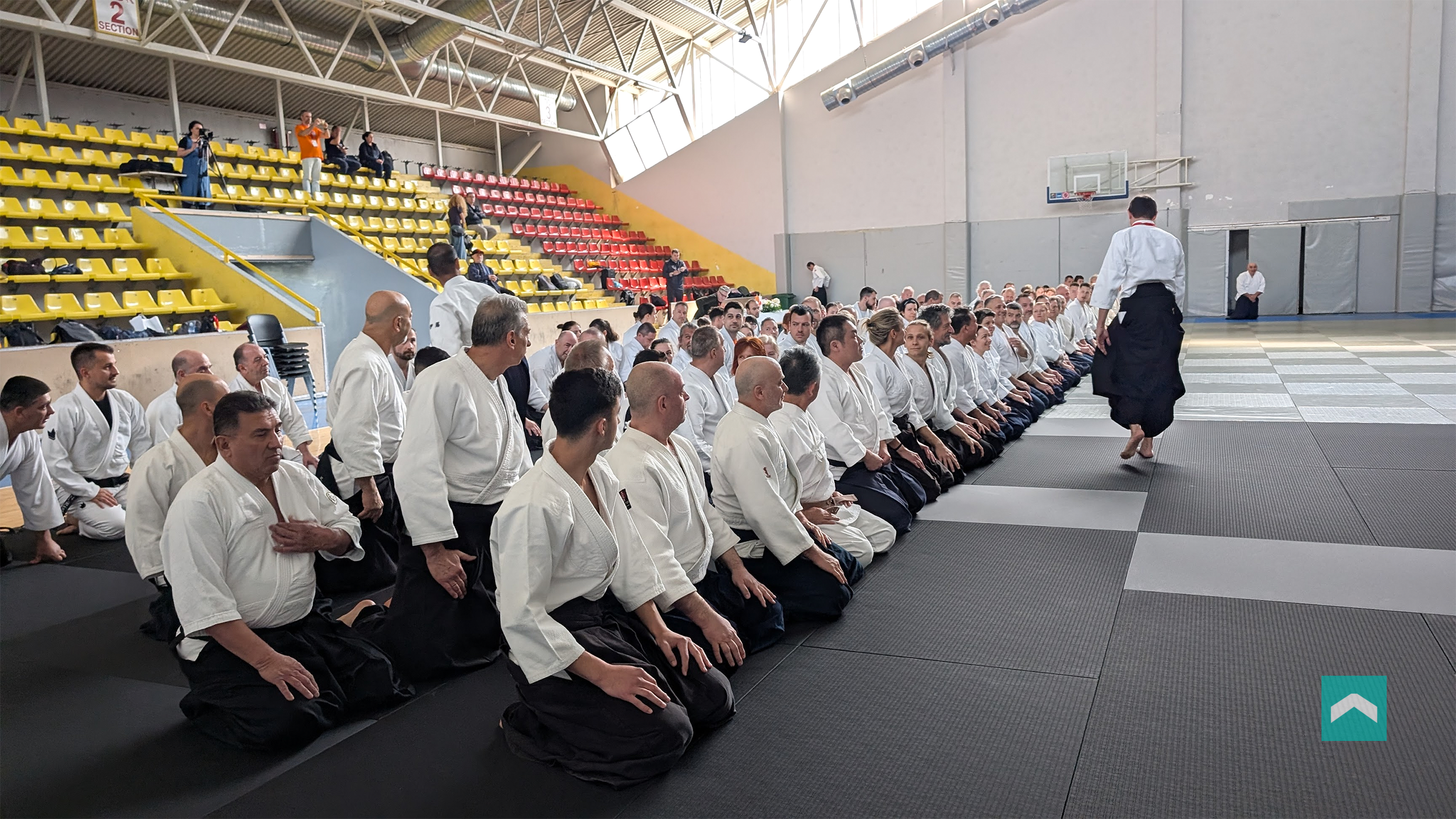
Two exercises I’ve been running recently.
Exercise A. Audience as jury
Two students come to the center. Everyone else sits and watches. The seated group picks the technique. The pair performs it several times. Then the audience analyses three things, one at a time.
The attack: was there enough fire? Too much? Was earth missing in uke’s posture? Did the attack have ma-ai or did it crash in?
The form: where in the technique did flow break? Was tori too rigid (too much earth) or too soft (too much water)?
The ending: did the technique finish, or did it dissolve? Did the kuzushi have a triangle in it, or did tori or uke give up commitment at the last moment?
Repeat with a new pair. After three or four rounds the dojo starts speaking a shared language. Students stop saying “it felt off” and start saying “the entry had no triangle” or “I lost my square at the end.”
Exercise B. Matching energy levels
We work on a 1 to 10 scale. One is the softest touch. Ten is your maximum.
Round one: tori and uke train at the same fixed level. Both commit to, say, level 5. Same intensity from both sides. Run the technique. The discipline of holding a defined level reveals how much of normal training drifts between intensities without anyone noticing.
Round two: tori and uke pick different levels. Uke attacks and takes ukemi on level 3. Tori works on level 8. This is where it gets interesting. When your partner gives you level 3 input, you can’t show level 8 on the outside. There’s nothing to push against. So how do you cultivate that intensity internally? Where does fire live in your spine, your breath, your intention, when there’s no force to meet?
This is fire as an internal quality rather than a visible one. It’s also where most practitioners discover they only know how to generate fire externally, by force. That gap is exactly the point.
The diagnostic, the part I find most useful
The single most practical move with this framework is to flip the question. Instead of “be balanced,” ask:
Which element are you overusing? Which element are you avoiding?
That’s more useful than trying to be all four at once. It gives you a direction.
Some patterns I notice on the mat. Practitioners who overuse fire (force, impatience, overcommitment) almost always avoid air. No spatial awareness, no pause, technique runs together into a rush. Practitioners who overuse water (flowy, accommodating, never quite landing) usually avoid earth (vague stance, no clear finish) and fire (no real entry, no commitment).
The instructor patterns are sharper. Many Aikido teachers I’ve watched, including myself in earlier years, overuse water. We make class feel pleasant. We blend with everything. We avoid pressure because pressure feels un-Aikido. The result: students get plenty of flow and almost no fire. They never learn to commit, because we never let them feel what real commitment costs.
That’s worth thinking about. If your dojo has been declining in retention or in advanced student development, the avoidance pattern is often the place to look first.
A self-check before your next class
Run these before you teach.
In the last month, which element have I leaned on most?
Which have I skipped?
When a student struggles, which element am I most likely to add: more flow, more structure, more pressure, more breath?
Which am I least likely to add?
Do the same for yourself as a practitioner. Which element shows up reliably in your technique under pressure? Which one disappears the moment things get uncomfortable?
There aren’t right answers. The diagnostic is the whole point. Once you can name what’s missing, you can start adding it on purpose, in small doses, in specific drills, with specific students.
What’s coming next
Part 2 takes the same diagnostic off the mat. Element imbalances in conflict at work, in difficult conversations, in how we handle pressure outside the dojo. The framework that helps us notice missing fire in irimi turns out to help us notice missing earth in a hard conversation, or missing air in an argument that won’t end.
This is one of many useful lenses. I’m not arguing it’s the only one or the deepest one. I’m sharing it because it works in the room, with adult students, in real time.
Aikido’s future depends on us. Join us. Forward this to practitioners, parents, or anyone tired of watching Aikido struggle instead of evolve.
Subscribe for practical insights from instructors who understand your challenges.