

TL;DR: The element diagnostic from Part 1 transfers off the mat. Same imbalances show up in conflict, work, and hard conversations, with two patterns from my own life included.
In Part 1 I laid out the four-element teaching map (earth, water, fire, air) and the diagnostic question I find most useful: which element are you overusing, and which are you avoiding? Two dojo exercises let students test it during aikido practice.
This part is about the same question off the mat.
The same diagnostic, different stage
Aikido practice is rehearsal. The mat is one of the few places in modern adult life where you get to feel pressure, contact, and consequence in a controlled setting, with real partners, several times a week. What you train there leaks into the rest of your life whether you mean it to or not.
The imbalances we notice in technique show up everywhere else: in how we handle a deadline, how we react to disagreement, how we hold (or fail to hold) a hard conversation. The body knows them first. The mind catches up later.
I’m not making a mystical claim here. I’m saying we are the same person in the dojo and at the dinner table. Whatever pattern dominates in our irimi tends to dominate in our arguments. Whatever element disappears under pressure on the mat tends to disappear under pressure at work. I wrote about this gap before in Why people really practice Aikido. Practitioners often find the practice helps them avoid physical confrontation but doesn’t automatically build the emotional tools for hard moments at home or with family. The element diagnostic is one way to start closing that distance.
That’s the door this part walks through.
The four elements off the mat
A short version of what each one looks like in life.
Earth
Structure, follow-through, boundaries, the willingness to land.
Too much earth: rigidity, defensiveness, refusing to move when the situation has changed.
Too little earth: no clear positions, drifting commitments, projects that never finish, conversations that go nowhere because nobody ever made a point.
Water
Adaptability, listening, accommodation.
Too much water: agreeing too easily, never landing on what you actually want, conflict avoidance dressed up as harmony.
Too little water: brittle responses, can’t read the room, breaks under pressure.
Fire
Initiative, intensity, decision, the willingness to commit.
Too much fire: impulse, urgency, picking fights without meaning to, overcommitting, burning relationships.
Too little fire: passivity, indecision, hoping things resolve themselves.
Air
Breath, distance, perspective, the pause.
Too much air: detachment, theorising, watching life from a balcony.
Too little air: no pause between trigger and response, conflicts that escalate because nobody stepped back.
Read those slowly. Most people will recognise themselves more in the excesses than in the deficiencies, because excesses tend to feel like virtues from the inside. “I’m just direct” (too much fire). “I’m just easygoing” (too much water). “I’m just principled” (too much earth). “I’m just observant” (too much air).
That’s the diagnostic doing its work. The framework gives you names for patterns you’ve been carrying around without noticing.
Two patterns from my own life
Here’s what this looked like for me recently.
I went to a seminar with a Hombu dojo Shihan. From an elemental standpoint, his Aikido is 100% water. Impeccable. There’s no break, no snag, the technique disappears into the next breath. That’s not a critique. He does it as well as anyone I’ve trained with.
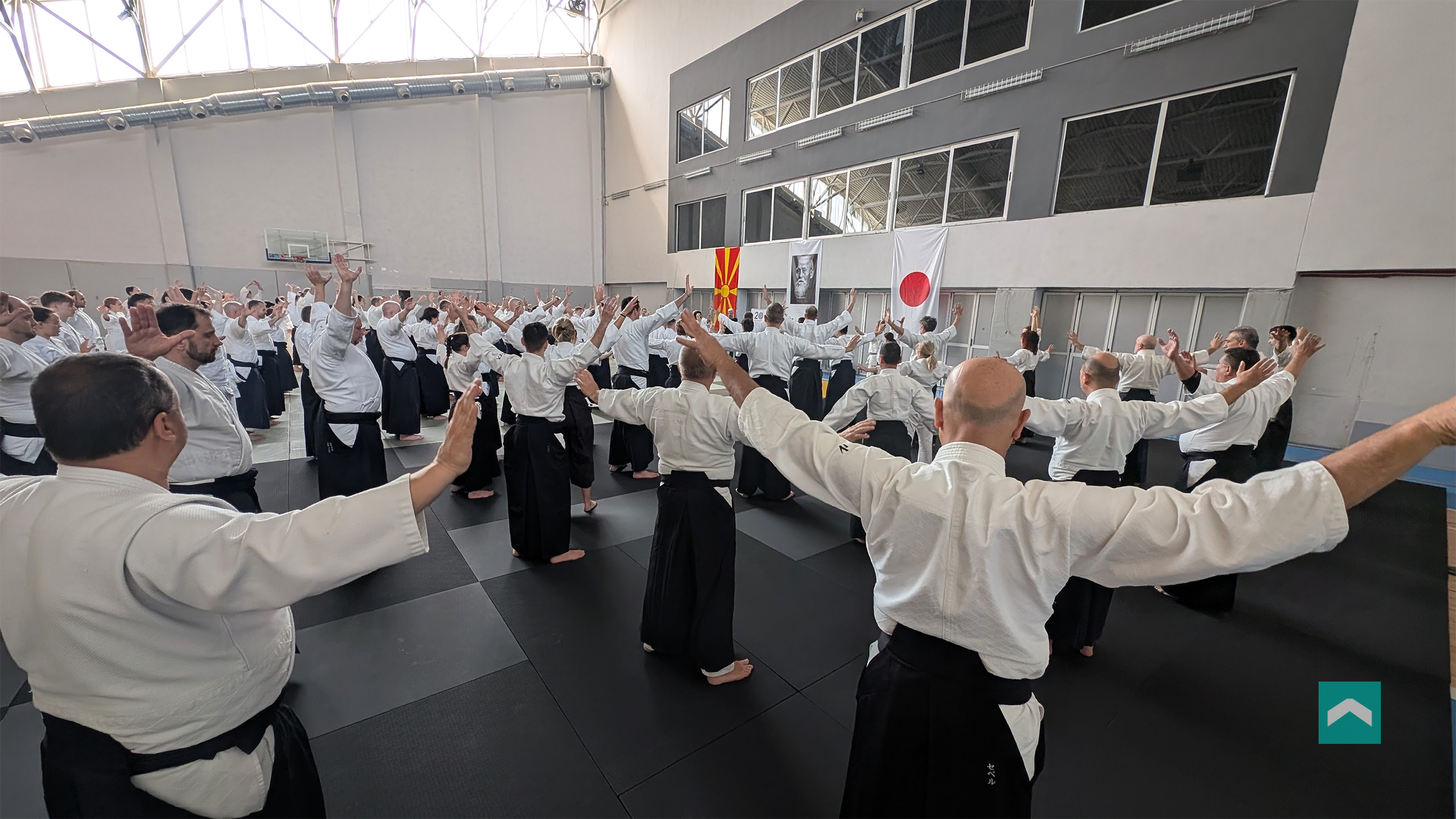
What I noticed wasn’t about him. It was about me, watching. Because in my own life, I’m also water-dominant, and for me that’s not always a compliment. I engage in many things. I enjoy the flow of them. I rarely finish or make the clean point at the end. I drift. To compensate for my natural habit, I need more structured practice with the square at the end. The defined finish. The earth element my real life has been missing. On the mat, that’s the work I called stability in From tension to flow: building structure that holds when your habits don’t.
That’s one direction.
Here’s the other. I’m also impulsive. I start things too eagerly. I create conflicts without realising it, usually because I poured fire into a moment that didn’t need it. Then it takes me time to cool down and steady my flow.
In life, that pattern has cost me. On the mat, I work on equalising triangle. Not to remove fire (I’d never want that). To use it on purpose, with timing, with permission, instead of reflexively. The mat is where I rehearse what I want to do better off it.
Notice the contradiction. I’m water-dominant in some domains and fire-dominant in others. The diagnostic isn’t a personality label. It’s situational. The same person can be too much of one element in one part of life and too much of another somewhere else. The framework only works if you’re willing to look at the specific situation, not at your “type.”
Beyond the dojo
This applies past Aikido too. Anyone who teaches, leads, mediates, or coaches works with element imbalances all day, whether or not they call them that. A team that overuses water (consensus, no friction) and avoids fire (clear decisions) drifts. A leader who overuses fire (urgency, pressure) and avoids air (no reflection, no pause) burns people out. A wellness practitioner who overuses earth (rigid programmes, fixed structures) and avoids water (adapting to the person in front of them) loses clients.
Practitioners like Mark Walsh, Wendy Palmer, and Richard Strozzi-Heckler have built whole careers translating these patterns into leadership and coaching contexts. We’ve covered that lineage in more depth in Presence is the practice. Part 4.
I’m not making the full case for that here. Just noting that the diagnostic crosses domains cleanly, because it’s about how humans respond to pressure, and humans are humans whether they’re on a mat or in a meeting.
An off-mat self-check
Run these after your next hard moment.
Last hard conversation: which element was I leaning on? Which one disappeared? What did the other person need that I wasn’t giving: more earth (a clear position), more water (real listening), more fire (genuine commitment), or more air (a breath, a pause)?
Last week: which element did I overuse without noticing? In which specific situation?
Last month: which element have I been avoiding consistently? What is the cost of that avoidance, in my work, my relationships, my training?
There’s no right answer. The diagnostic is the practice.
One useful map among many
The four-element frame isn’t the deepest map of Aikido or of life. It’s a useful one. It works because adults can name patterns they couldn’t name before, and naming a pattern is most of the work of changing it.
Like everything else worth practising, this gets better with attention and worse with avoidance. The mat is one place to work on it. Your week is another.
Aikido’s future depends on us. Join us. Forward this to practitioners, parents, or anyone tired of watching Aikido struggle instead of evolve.
Subscribe for practical insights from instructors who understand your challenges.