


TL;DR: Injuries can force a re-mapping of internal movement patterns that reveals dimensions of aikido most practitioners never discover. Sports science confirms this is more than recovery; it is genuine skill development.
I asked the aikido community about their injuries and lessons learned (see Part 1 and Part 2). None of the many responses mentioned what happened to me.


They spoke of becoming safer, more aware of partner choice and limits, and of teaching flaws - valuable lessons all.
But none described my experience: an injury that forced me to re-map my internal sense of movement. Not just adapting around pain, but uncovering layers of motion I had never reached in a decade of practice.
When strength stops working
The throw should not have hurt, but something in the angle or timing went wrong, and my shoulder stayed damaged for a year.
It was not sharp pain that stops you immediately, but a dull ache buried deep in the joint, reminding me with every shortcut, every muscled movement, every time I relied on strength instead of structure.
Powering through was no longer possible. Each forced technique drew instant protest, pushing me to find another way.
At first it felt limiting. I was compensating, doing less. But months later something shifted: I began noticing details I had ignored—subtle weight shifts that reduced strain, angles that worked with less effort, ways of redirecting force without shoulder power.
Pain taught me to feel through technique instead of think through it, to sense internal mechanics rather than perform external form.
The knee taught me the same lesson differently
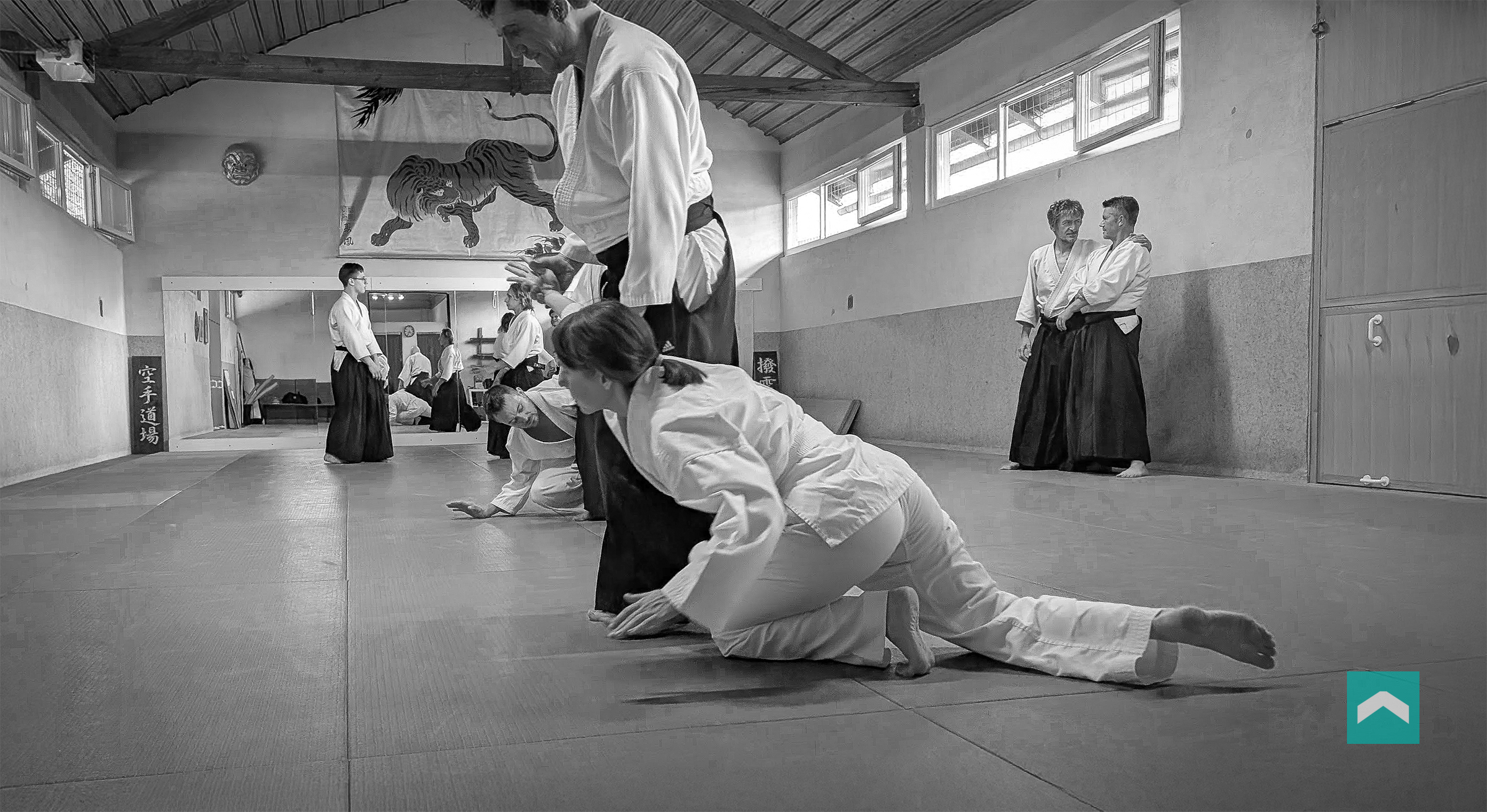
A few years later, my knee gave out from shikko games with students half my age. I was too old for that kind of play, but ego ignores cartilage.
Another year of pain. Another re-mapping.
This time I recognized the pattern. The injury did not just limit movement; it pushed me to find new internal pathways: power from hips instead of knees, subtle shifts that allowed kneeling techniques without strain, timing adjustments that softened impact yet kept effectiveness.
These were not workarounds but improvements—more efficient, sustainable, and aligned with what aikido should teach.
Pain revealed what a decade of normal training had not. Each technique holds multiple internal pathways, ways of organizing movement for the same outward effect.
Once you feel that, practice transforms. You are no longer locked in one pattern but gain options, flexibility, and movement intelligence that make you adaptable, resilient, and creative in response to partners and situations.
What I realized about aikido teaching
What bothered me was this: why did it take injury to reveal it?
After more than a decade of training, no instructor had shown that techniques could emerge through different internal pathways. No one mentioned that the same form could arise from hip rotation, shoulder structure, weight shift, breath, or their combinations.
Teaching focused on external form—move like this, step here, hand there—until it looked right.
The inner organization that makes those movements possible, the subtle shifts of effort through the body, the many ways to generate the same result, remained invisible.
Not from secrecy but from unawareness. My teachers had mastered and passed on form, not the underlying mechanics, which stayed unconscious and therefore unteachable.
Pain made them visible. It forced me to notice what normal training never demanded, and once seen, it could not be unseen.
Why this matters for everyone
You do not need injury to develop movement intelligence, but you do need training that makes internal mechanics conscious and explorable.
That is what got lost. Somewhere in aikido’s evolution, focus shifted to external form. Internal exploration became secondary or disappeared from many teaching lines.
Sports science calls what I experienced motor learning through movement re-mapping. When pain blocks habitual patterns, the nervous system searches for alternatives. This is not compensation but neuroplasticity, the brain building new movement pathways.
Research on athletes confirms it. When forced to adapt, they often create more efficient movement patterns. Necessity drives depth of exploration that normal training rarely demands.
Studies show three key benefits of injury-driven re-mapping:
Enhanced self-awareness. Athletes learn to consciously reflect on their movement patterns rather than operating on autopilot. They develop the ability to notice subtle differences in how they organize movement internally.
Increased mental toughness. The process of working through injury builds persistence and problem-solving capability that transfers to other challenges. They learn they can find solutions when obvious paths are blocked.
Improved motor control. Breaking down movements into components and rebuilding them creates better biomechanical efficiency. The reconstructed movement is often superior to the original pattern.
This process represents genuine skill development born of necessity and exploration.
Making it accessible without injury
How can we make this kind of exploration part of regular training, not just something injury survivors discover?
Some methods in the Teach Better section address this: teaching that makes internal mechanics visible, training that explores multiple pathways through the same technique, and exercises that build proprioceptive awareness instead of mere form imitation.
My article From Tension to Flow maps internal milestones between beginner tension and advanced flow. When you cannot rely on habit, you find subtlety, the same lesson injury taught me, but intentionally.
The key is to make internal exploration deliberate from the start. Teach students to feel how they organize movement, to experiment with generating the same effect in different ways, and to find alternatives when habits fail.
This approach does not replace technical teaching; it enhances it. Students still learn form, timing, and spacing but also gain awareness of the internal mechanics that make those forms work and the flexibility to adapt them to their own structure.
The conversation we need
What I experienced through injury is not unique. Many practitioners face it but lack words or frameworks to understand it.
I share this not because it is remarkable, but because it reveals something missing in aikido teaching, a dimension available to all yet rarely made explicit.
If you have had an injury or moment that forced you to move differently, share it. Such stories build collective insight, giving instructors new perspectives and students freedom to explore beyond rigid form.
Teaching improves when we make the unseen visible. With shared language for internal mechanics and movement intelligence, mystical ideas become practical, teachable skills.
Your experiences matter. Whether they came through injury, exploration, or good teaching that revealed internal mechanics, that knowledge helps us all train smarter. Share yours in the comments to improve how aikido is taught.