


TL;DR: The deepest cost of aiki-consumerism isn’t financial. It’s the practitioner who collected certificates while something more essential didn’t get built — and who finds that out not on the mat, but in ordinary life.
In Part 1 we traced how rank became a product. In Part 2 we examined the costs—in money, time, and the functional investments we bypassed instead. This part is about a cost that appears on no ledger.
“I haven’t been attacked very many times,” Mark Walsh told us, “but I’ve been in a lot of arguments.”
Walsh has practiced Aikido for twenty-five years and built a global embodiment practice centered on what the art can achieve beyond the dojo walls. He works with trauma educators in Ukraine and coaches in forty countries, spending years analyzing the gap between physical skill and real-life function. His observation about arguments lands with precision because most long-term practitioners already know exactly what he means—they just rarely say it out loud.
The gap we trained around
Rank systems measure what is measurable: time on the mat, technical execution, knowledge of the curriculum, and—in most organizations—the approval of those above you in the hierarchy. They reward loyalty, presence, and participation.
What they do not measure is whether years of training changed how you handle a difficult conversation. They do not measure whether you stay grounded under sustained pressure at work, or whether the practice transferred beyond the dojo at all.
Rob Liberti captures this plainly in his writing on transmission. Rank tends to reward time and loyalty rather than structural coherence, internal organization, or functional stability. “A system built to certify presence rather than transmission produces a predictable result: practitioners who have invested decades with total sincerity, but who occasionally—in cross-training or during a particularly hard week—feel the gap.”
It is not a gap in technique. It is a gap in what the technique was supposed to build.
The moment you feel it
Some feel it on the mat first. A 4th dan touches hands with someone from another martial art, and something doesn’t add up. The certificate implied a specific competence; the encounter says something else. It is uncomfortable, and then clarifying. The grading system measured something real—just not this.
Others feel it entirely off the mat. A tense meeting. A conflict at home that refuses to resolve the way a technique resolves. As Mark Walsh notes: “You may be very calm when someone is trying to hit you with a bokken, but if someone insults you—that might be more difficult.”
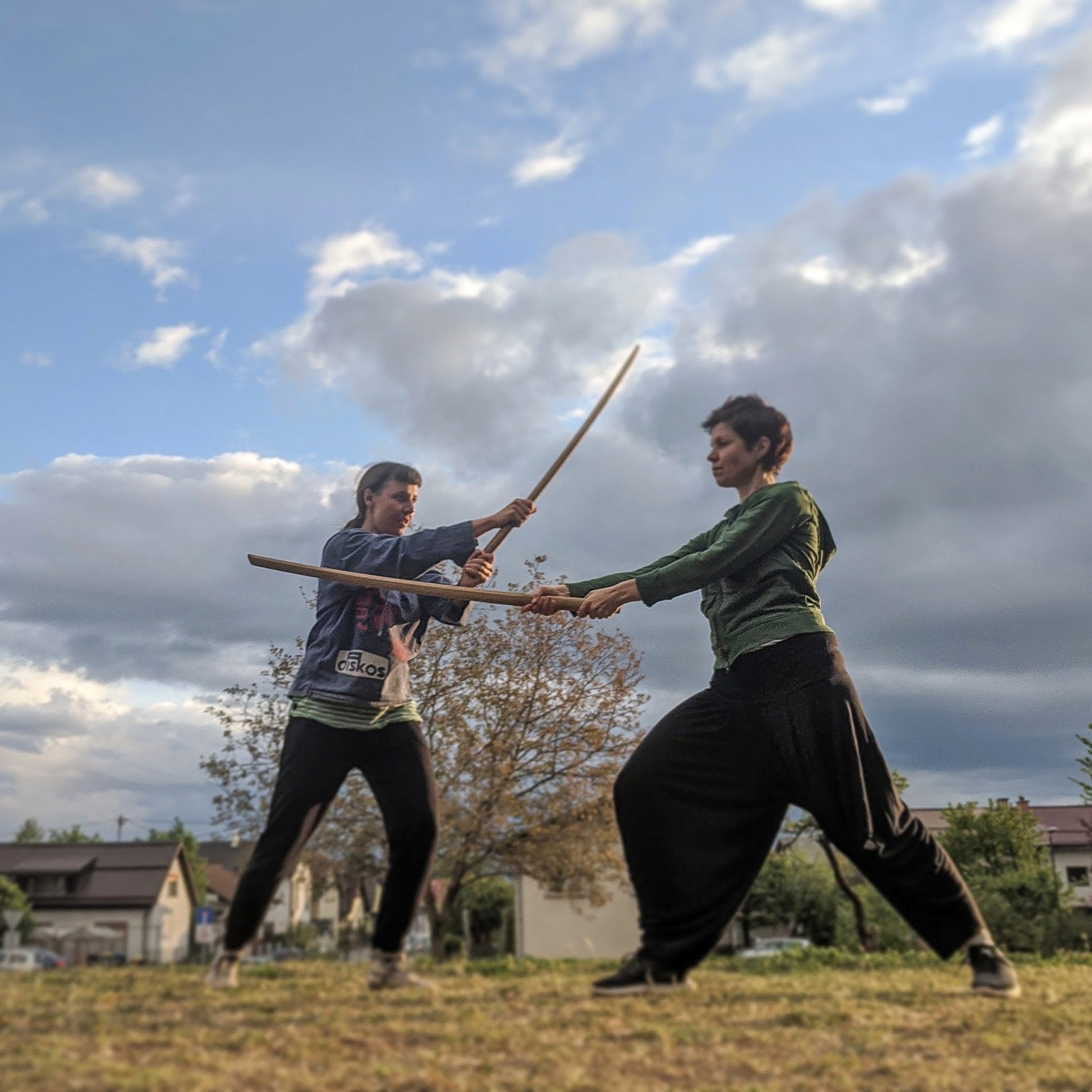
Both are the same signal. The training built exactly what it was designed to build, but the system was never designed to build what we actually needed.
This is uncomfortable to sit with because most of us practiced in good faith. We showed up, trained seriously, and graded when the system told us to grade. We trusted that the structure knew what it was building.
The identity trap
This shift is logical. Decades of investment build an identity; to question the rank is to question years of your own life. Yet another force is at work—what Voarino called “knowledge bowing to ignorance”. Practitioners reach a level of development the institution was never designed to certify, yet they still seek its stamp of approval. Standing on your own assessment requires more confidence than most systems ever encourage.
Here, the succession becomes relevant. Certificates continue to flow from an institution whose leadership is generationally removed from the conditions that made those ranks meaningful—and from the training intensity that once gave them weight.
Hiroshi Isoyama—an 8th dan, Technical Councillor, and direct student of the founder—named the consequence of this drift: “If you fail to exert your strength, even when you are able to, some part of you will remain dissatisfied, and you will stop believing in Aikido.”
Isoyama was discussing training methodology, but the principle extends. Mitsuteru Ueshiba—the heir apparent—did not train in the rigorous live-in culture of the Iwama dojo. A system that softens and certifies without requiring that foundational intensity produces practitioners who eventually stop believing in what they have built. The art did not fail them. They were simply never pushed to the place where they could find what the practice offers.
Extending the do
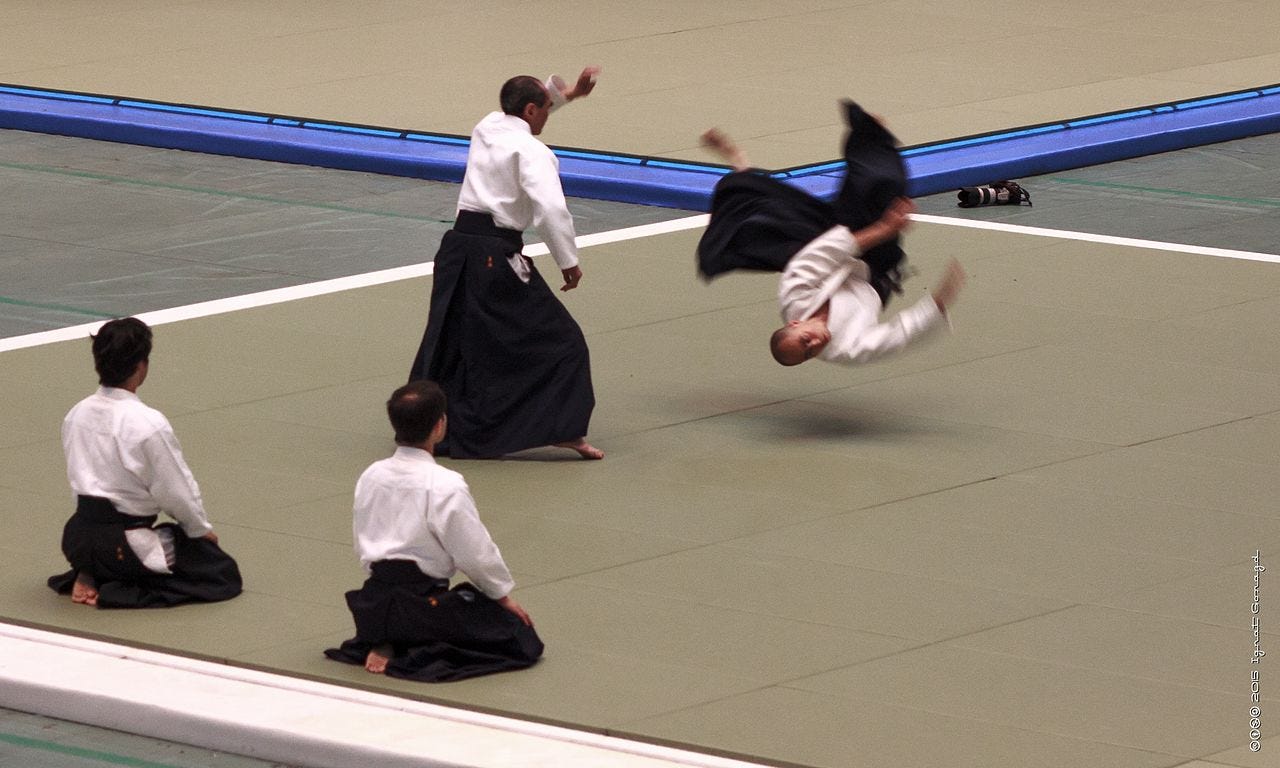
The examples are already there. Hiroshi Tada—a 9th dan and one of the most respected teachers alive—has spent decades drawing from sources far outside the conventional curriculum: yoga, esoteric Buddhism, Zen, and the teachings of Lao-tse. At the 2004 IAF Congress, he argued that the spirit of budo is rooted in universal truths that practitioners must search for across many traditions.
.jpg)
He also offered a challenge: “Aikido is more beneficial to humanity than is generally realized.”
That sentence only makes sense if we acknowledge a gap. If the art is more beneficial than realized, then the distance between its potential and its current delivery is significant. The certificate economy is a primary reason this gap persists. A system that measures loyalty over depth and title over ability, will always under-deliver on the art’s promise.
My own dojo has moved in this direction. Under one roof, practitioners access karate, kenjutsu, jujitsu, and yoga alongside Aikido—different disciplines and different teachers in one space. This is not a mixed curriculum, but a shared one, supplemented by guest instructors from various fields. It grew this way because the people training there have specific needs, and meeting those needs matters more than maintaining a narrow program.
Practitioners filling these gaps are not rejecting Aikido. They are taking it seriously enough to ask what it is supposed to build in a person—and then working toward that, certificate or not.
What’s coming next
In Part 4 — the certificate economy sustains itself as long as practitioners fund it. The more interesting question is what happens when they don’t.
Community question: Has there been a moment — on the mat or off it — when you felt the gap between your rank and what you’d actually built? What did you do with it?
Hello - I read with interest Parts 1, 2, and 3 of your series on the "Dan Economy". There are many aspects I agree with, and some I do not. However, at this stage I am not sure where the series is going nor what you think we should do to address the issues you put forth.
My take away from Part 1 was "A lot of people today have high dan ranks and shihan certifications even though their skill level is not very impressive."
I don't disagree with this, but it is irrelevant to my personal practice. From a global standpoint, however, I suppose this could be called a problem. As more and more unskilled "shihan" percolate through the worldwide aikido community, the overall level of the art will inevitably be diminished. However, based on my experience there are precious few exceptional teachers in the art, and sadly they may not be with us very much longer.
This is an aside, but I will also comment that there are today, and probably have always been, very few people who are able to or interested in devoting their life to aikido. For most students it is a pleasant hobby which allows them to get some exercise and enjoy being with friends. I'd be interested to hear your thoughts on how to sustain some level of excellence in a community populated by mostly amateur hobbyists (with spouses and kids and mortgages and aging parents...)
My understanding of Part 2 was "Dan ranks from Aikikai are rather expensive, and many organizations tack a fee on top of the Aikikai fee making them even more expensive. Perhaps this money could be better used to help individual dojos invest in ways to improve the level of teaching in the dojo."
I don't entirely disagree with this sentiment either. Personally, I am fortunate to belong to an organization that simply does a pass-thru on the Aikikai dan fees -- no extra charges.
Again, however, I think it is important that there be an Aikikai and I believe there is value in having a "mother ship" type organization. I don't mind paying the dan fee once or twice a decade to support the Aikikai.
My understanding of Part 3 was -- actually, I'm not sure what you wanted to say in Part 3. That aikido is not effective for fighting and we should cross-train in other arts? That people doing aikido are wussy? That aikido is not a "real martial art™"? That even people with a high dan rank can be assholes?
I suspect that you are building up to a proposal for how to address and rectify these perceived organizational and pedagogic shortcomings in our art, so I will look forward to Part 4.